

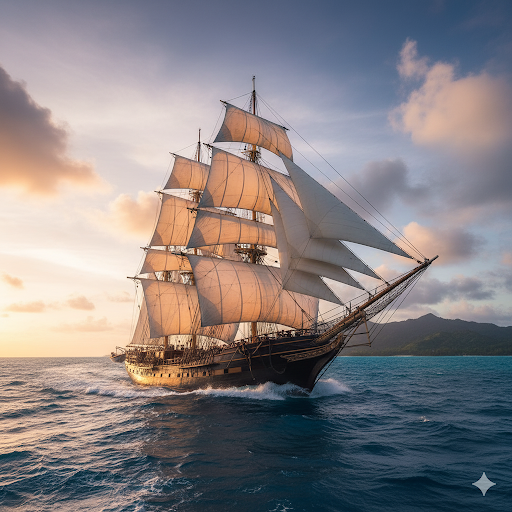
Here at Island Coffee Traders, we are custodians of a legacy steeped in the rich, volcanic soil of the Blue Mountains. We talk often of terroir—the unique combination of altitude, climate, and earth that gifts Jamaican coffee its unparalleled smoothness and mild, complex flavor. But what if we told you that one of the most crucial elements in the history of coffee’s flavor profile wasn’t found in the soil at all but in the rolling hold of a sailing ship?
Before the Panama Canal, before temperature-controlled containers, there was the long, slow sea voyage from the ports of Kingston to the eager coffee houses of London and Paris. This journey, once considered a mere logistical hurdle, accidentally invented one of the world’s first and most unique aging processes: sea-seasoning.
A Happy Accident of Necessity
In the 18th and 19th centuries, coffee was a valuable export, but a perishable one. Bagged in burlap and jute, it was loaded into the wooden hulls of sailing vessels. For weeks and sometimes months, these sacks were exposed to an environment we would now consider a coffee broker’s nightmare:
Constant Humidity: Sea air is profoundly salty and humid, permeating every fibre of the burlap sacks.
Significant Temperature Swings: The hold of a ship would be cool and damp at night and swell with tropical heat during the day.
The Ship’s Motion: The coffee wasn’t just stored; it was in a state of constant, gentle agitation for the entire journey.
When this “green” (unroasted) coffee finally arrived in Europe, merchants discovered something astonishing. The coffee that had endured this arduous journey tasted noticeably different—and better—than coffee shipped over land or on shorter routes.
It had shed any remaining astringency or grassy notes sometimes found in fresh green coffee. The flavor profile became remarkably rounded, mellower, and developed a deeper, richer body. The beans had, in essence, been “pre-aged” by the ocean itself. This “sea-seasoned” coffee became highly sought after and commanded a premium price, cementing the reputation of Jamaican coffee as a luxury product long before the term “Blue Mountain” was formalized.
The Science of the Salt-Kissed Bean
We can now use modern science to deconstruct this centuries-old accident. The ocean voyage created a perfect, if extreme, natural processing environment:
1. Controlled Degradation: The constant humidity and temperature fluctuations slowly broke down the complex carbohydrates and proteins in the raw bean through hydrolysis. This natural chemical process pre-mellowed the acids, reducing bitterness before the bean was even roasted.
2. The Salt Air Influence: Microscopic salt particles in the humid air likely permeated the porous burlap and interacted with the bean’s surface. This tiny saline presence could have subtly enhanced the perception of sweetness and complexity, much like a pinch of salt in a cake recipe enhances flavor without making it taste salty.
3. Gentle Agitation: The relentless rocking of the ship prevented the coffee from settling and becoming stagnant. It ensured even exposure to the unique environment and prevented mold, allowing for a slow, steady transformation instead of spoilage.
From Nautical Accident to Modern Innovation
The tradition of sea-seasoning largely died with the advent of faster steam ships and modern storage. However, the principle behind it—that controlled environmental exposure can profoundly improve coffee—is experiencing a renaissance among innovative coffee producers.
Today, pioneers are experimenting with “ocean-aged” coffee, deliberately sending containers of green coffee on long sea voyages to recreate this historic effect. Others are mimicking the conditions in climate-controlled rooms, using salt-infused air and precise humidity controls to accelerate the process.
At Island Coffee Traders, we see this not as a recipe to be replicated but as a profound reminder of coffee’s journey. It connects every cup we brew today to a history of adventure, serendipity, and the quest for perfection. That signature smoothness we cherish in a cup of Blue Mountain isn’t just born from the mountain; it’s a flavor that was truly forged by the sea.
So, the next time you sip our coffee, know that you are tasting the legacy of sun-bleached sails, trade winds, and the patient hand of time. It’s a taste history itself perfected.
Island Coffee Traders is dedicated to uncovering the stories behind the brew. We honor the past while innovating for the future, always ensuring the coffee in your cup is a remarkable experience.

Recent Comments