

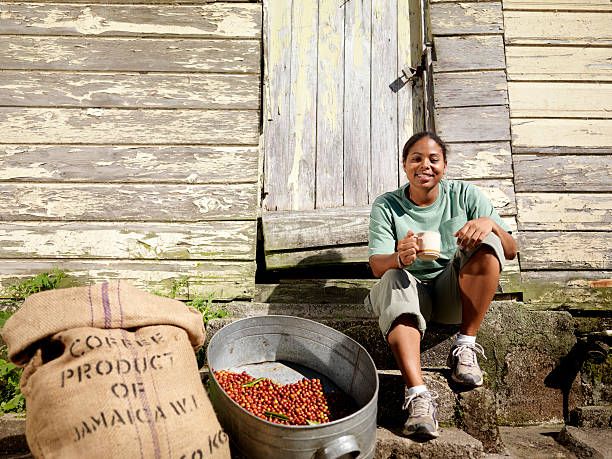
For decades, Jamaica’s Blue Mountain coffee has occupied a rarefied space in the global specialty market—revered, debated, and priced like fine Bordeaux. Whether it truly sits alone at the summit of world coffees is a question that fuels endless cupping-table debates. What is beyond dispute, however, is the extraordinary fragility of this origin. And in the past 18 months, that fragility has been laid bare by back-to-back hurricanes that have reshaped supply, pricing, and the very future of the island’s most famous agricultural export.
The Damage Report: A Double Strike
Hurricane Beryl made landfall on July 3, 2024—an early-season Category 4 storm that intensified with shocking speed. Though its core battered Jamaica’s south coast, the Blue Mountain range absorbed torrential rains and damaging winds that stripped immature cherries from trees already stressed by drought earlier in the year. Initial assessments estimated 15–20% crop loss in the eastern parishes.
Then in late October 2025 came Hurricane Melissa later in the season—a second system that tracked closer to Portland and St. Thomas, delivering a coup de grâce to much of the remaining mature crop. The combined toll:
· Nearly 40% of mature coffee cherries destroyed across the appellation
· Farm-gate losses estimated at J$1.5 billion (approximately US$9.7 million)
· Over 800 smallholder farmers directly affected
· Significant infrastructure damage: washed-out access roads, collapsed drying patios, and damaged processing equipment at several washing stations
· Landslides in the steepest growing areas, uprooting trees and burying young plantings
· Fungal outbreaks (leaf rust and berry borer) in the weeks following the storms, exacerbated by persistent moisture
For an appellation that produces only about 15,000 acres of coffee in total—roughly 85% of which is pre-sold to Japan—this represents a seismic contraction in global availability. Prices at origin have already climbed by over 15% since November 2025, and forward contracts for 2026/2027 are being renegotiated with nervous buyers.
A History Etched by Hurricanes
Older growers still speak of Hurricane Gilbert (September 1988) with a shudder. That Category 5 monster—with 155 mph winds and 27 inches of mountain rain—destroyed 70% of all coffee trees. It took nearly two decades for quality production to return to pre-storm levels. The 2024–2025 season is not Gilbert-level devastation, but it arrives at a time when the average age of coffee farmers is rising, and younger generations are gravitating toward Kingston, Miami, or London.
The difference today is that the global specialty market has diversified. Twenty-five years ago, Jamaica Blue Mountain had few peers. Now, artisanal microlots from Ethiopia, Colombia, and Costa Rica offer stiff competition. Yet no other origin carries quite the same mystique—or the same production risk.
Recovery Efforts: Rebuilding from the Roots
In the aftermath of Melissa, JACRA (the Jamaica Agricultural Commodities Regulatory Authority) —the government body responsible for regulating and promoting the island’s agricultural exports—mobilized quickly alongside the Ministry of Agriculture. However, resources remain stretched across multiple affected crops. Current recovery initiatives include:
· Emergency pruning programs – JACRA-certified extension officers are training farmers in regenerative pruning techniques to salvage damaged trees and encourage new suckers for the 2026 crop.
· Disease control spraying – Subsidized fungicides and insecticides are being distributed through JACRA’s network to contain post-storm outbreaks of rust and borer.
· Road rehabilitation – The Rural Agricultural Development Authority (RADA) is prioritizing repairs to mountain access routes, though many remote farms remain reachable only by foot or helicopter drop.
· Replanting subsidies – JACRA has coordinated a J$200 million seedling distribution program, but nurseries are struggling to meet demand. Each new tree takes 4 years to bear commercial cherries.
· Farmer support payments – Emergency cash transfers of J$50,000 per affected grower have been announced through JACRA’s disaster relief fund, though disbursement has been slow due to verification challenges.
· Soil remediation – Landslides stripped topsoil from many slopes; JACRA is promoting compost and cover-crop initiatives to prevent erosion ahead of the next rainy season.
· Quality assurance – JACRA has increased its cupping and grading oversight to ensure that any coffee reaching export markets still meets the strict standards for Blue Mountain certification, despite the pressure to rush damaged lots to market.
Despite these efforts, the reality is sobering: full production will not return until at least 2028. Many older farmers are choosing to exit the industry altogether, citing rising costs and diminishing yields. The average age of a Blue Mountain coffee farmer is now 62 years, and succession planning remains a critical challenge that JACRA has identified as a long-term strategic priority.
What This Means for Island Coffee Traders
For our buyers and roasting partners, the 2025–2026 season translates into three realities:
1. Tight supply, firm prices – Expect allocated lots and shorter contracting windows. We are fortunate to have secured small parcels from a handful of estates before Melissa struck, but our 2026 offerings will be significantly reduced.
2. Elevated quality scrutiny – Some lower-altitude farms may rush to harvest damaged cherries. We will cup every lot twice—and work closely with JACRA’s grading officers—to reject any lot that fails our internal score.
3. A story worth telling – This is not a year for bargain hunting. It is a year for honoring the farmers who risk everything on a mountainside. Each bag from this harvest represents survival—of trees, of family legacy, and of a flavor profile that cannot be replicated anywhere else on earth.
Limited Availability – Including Peaberry and Select
Despite the catastrophic losses, we are pleased to offer a small allocation of the following grades, all certified by JACRA’s rigorous inspection process:
· Jamaica Blue Mountain Grade 1 (washed, screen 17/18) – strictly limited
· JBMC #2 Peaberry – the rare, single-bean mutation prized for its concentrated brightness and sweetness; even scarcer this season
· Jamaica Blue Mountain Select – a carefully hand-sorted lot representing the finest visual and cup quality from the estates we work with
Quantities are extremely tight. We anticipate our total Blue Mountain offering for 2026 to be less than 40% of our usual volume. Interested roasters are encouraged to secure allocations immediately.
Looking Ahead
Recovery from back-to-back storms will take at least three to five years. New plantings take four years to bear fruit, and many farmers lack the capital to replant at scale. Climate models suggest the Caribbean will face more intense, earlier-season storms in the coming decade.
Yet, if history teaches us anything, it is that Blue Mountain growers are relentlessly stubborn. The same steep slopes that make farming hellish also make it defensible—these are not vast plantations but tiny, hand-tended plots woven into cloud forest. And as long as families keep coffee in their blood—and JACRA continues its regulatory and promotional mandate—this origin will endure.
We are privileged to offer what little we have. Drink it slowly. It may be a while before we see its like again.

Recent Comments